
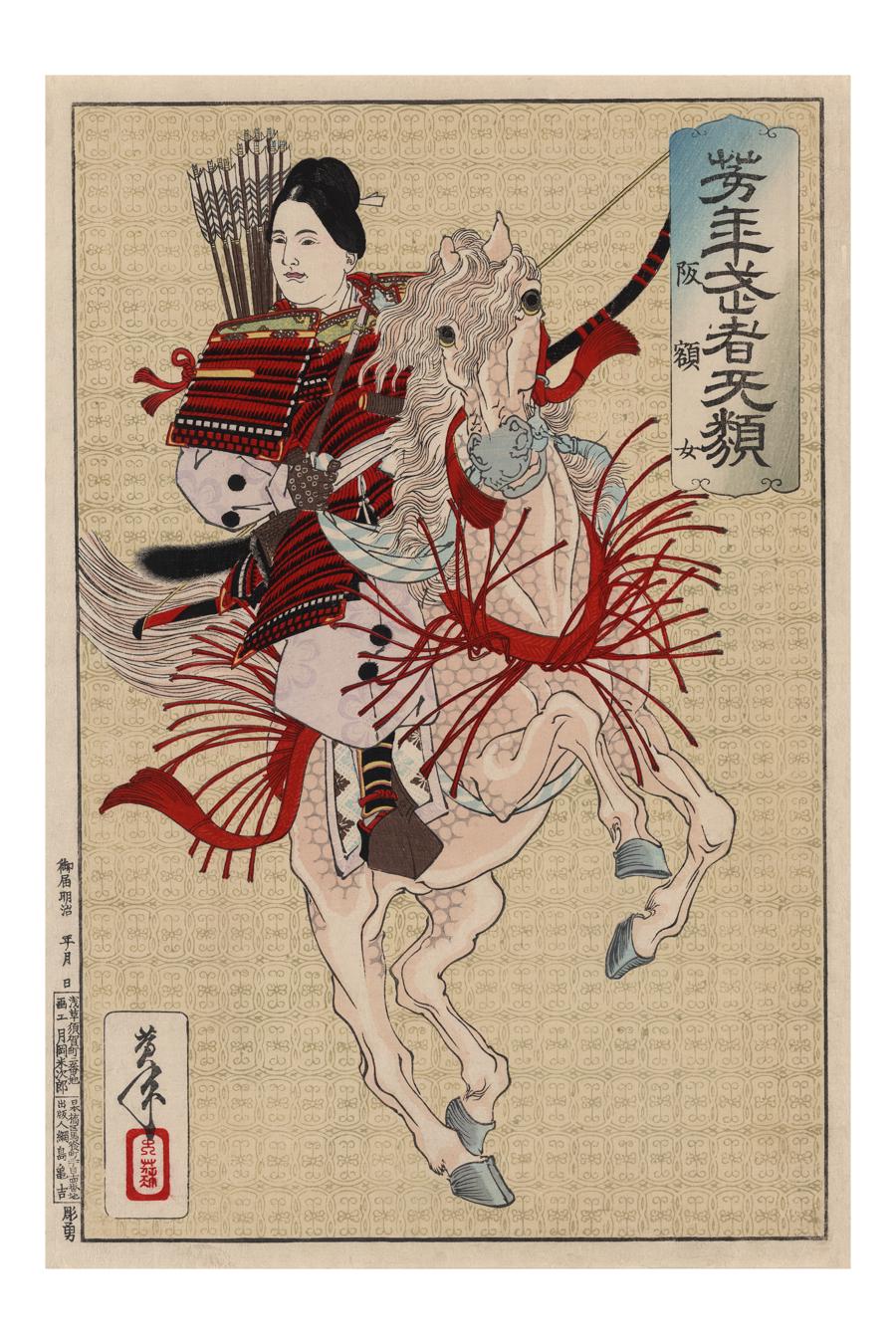
The striking figure shown in this print is Hangaku Gozen, a documented female warrior, or onna-musha (女武者), associated with the Kennin Rebellion of 1201. Her story appears in medieval Japanese war chronicles, most notably the Azuma Kagami, which records events of the Kamakura shogunate.
According to those accounts, Hangaku Gozen took part in the rebellion led by the Taira clan against the Kamakura government. During the conflict, she is described as having commanded defensive forces at Torisaka Castle. The chronicle records that she continued to direct the defense; "...Hangaku stood on the tower of the castle and all those that came to attack her were shot down by her arrows which pierced them either in their chests or their heads" until she was pierced by an arrow to the thigh and captured. After the rebellion was suppressed, she was taken to Kamakura where she was presented “fearless as a man and beautiful as a flower,” as a prisoner of war to the Shogun.
Her presence in historical records is one of the reasons she remained a recognizable figure in later Japanese culture. While women associated with the samurai class—often referred to as onna-bugeisha—were trained in martial skills and could participate in defense, individuals like Hangaku Gozen appear only occasionally in surviving written accounts. Her role in the rebellion made her an unusual and notable subject.
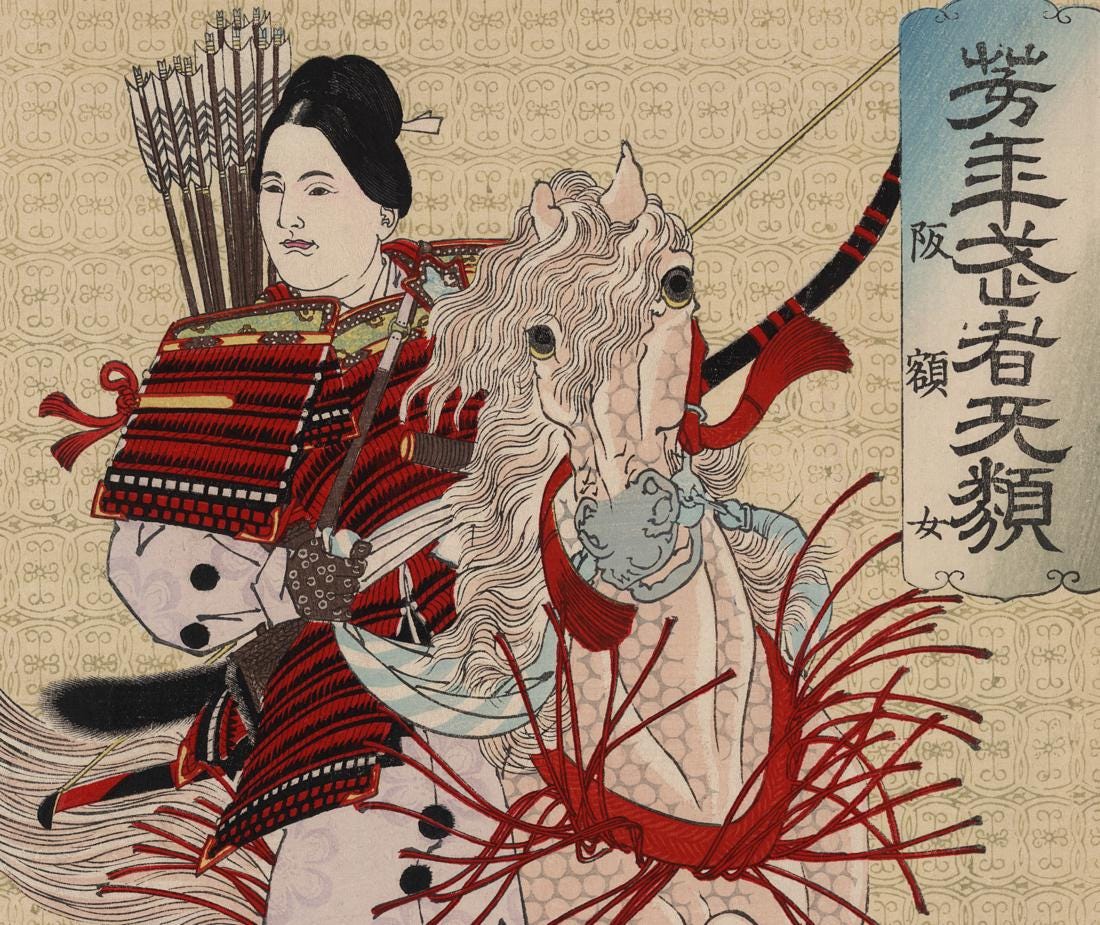
Centuries later, her story became part of the subject matter for ukiyo-e artists. During the Edo period, woodblock prints frequently depicted historical warriors drawn from earlier chronicles and epics. These images were not created as documentary records but as visual interpretations intended for a popular audience.
Artists such as Utagawa Kuniyoshi were particularly known for producing prints of historical and legendary warriors. Kuniyoshi’s work, along with that of other artists in the Utagawa school, often emphasized dramatic composition, stylized armor and clothing, and clearly defined poses that made the figures visually distinct.
Prints of Hangaku Gozen belong to this broader tradition. They present her as a fully realized warrior figure, often equipped with weapons and dressed in the style associated with samurai imagery in ukiyo-e. These representations reflect the conventions of the genre rather than attempting to reconstruct her exact historical appearance.
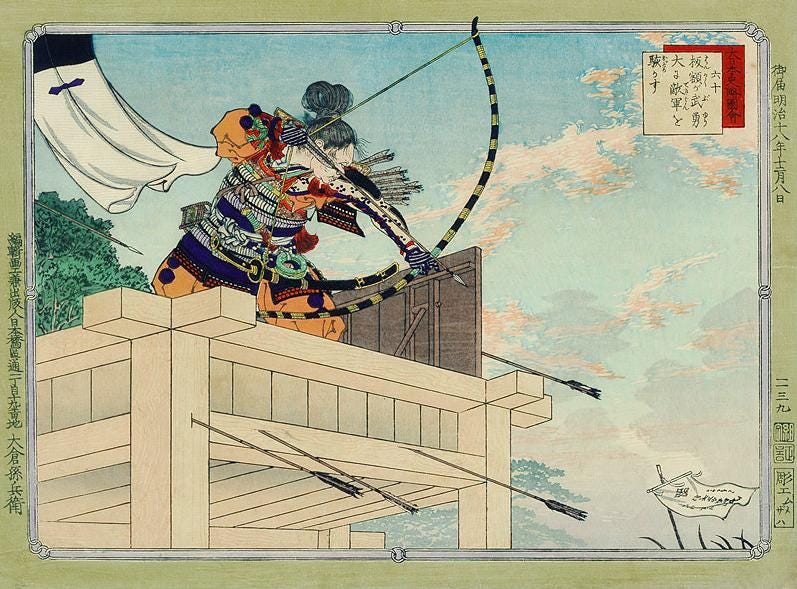
The continued production and circulation of these prints during the Edo period shows how figures from earlier Japanese history were preserved and reinterpreted through visual media. Woodblock printing allowed for wide distribution, making these images accessible beyond elite audiences.
Today, prints depicting Hangaku Gozen serve as both historical reference points and examples of ukiyo-e design. They connect a recorded event from the early 13th century with the visual culture of Edo-period Japan, illustrating how historical figures were transmitted across time through text and image.
The result is a layered record: a medieval chronicle, retold and reshaped through 19th-century printmaking, and still recognizable today.