
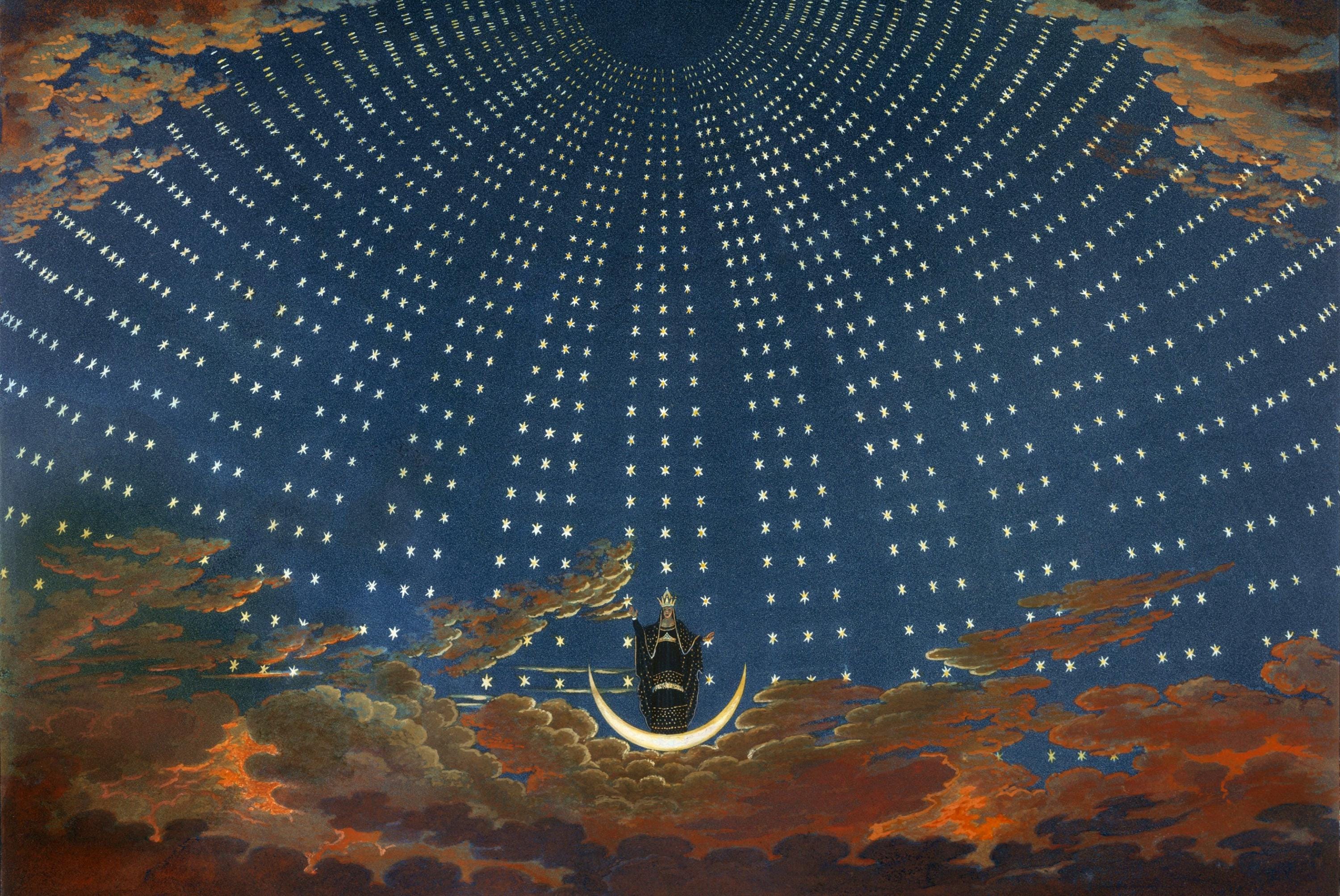
This is one dramatic peice that I'm sure caught your eye, and once you know what you’re looking at here, it gets a lot more interesting. This isn’t just a decorative celestial scene - it’s stage design for an opera. Specifically, it’s a rendering of “The Hall of Stars in the Palace of the Queen of the Night” from Act 1, Scene 6 of The Magic Flute.
The image is attributed to K.F. Thiele, working after the designs of Karl Friedrich Schinkel, one of the most influential designers of the 19th century. And suddenly, this isn’t just about stars and atmosphere. It’s about theater—and how ambitious it used to be.
Mozart’s The Magic Flute, first performed in 1791, is already a strange and fascinating piece on its own. It blends fairy tale, philosophy, comedy, and symbolism in a way that doesn’t quite fit into a single category. You’ve got magic instruments, trials of wisdom, comic relief characters, and then, right in the middle of it all, the Queen of the Night - arguably one of the most dramatic roles in opera. And she doesn’t just appear - she arrives.
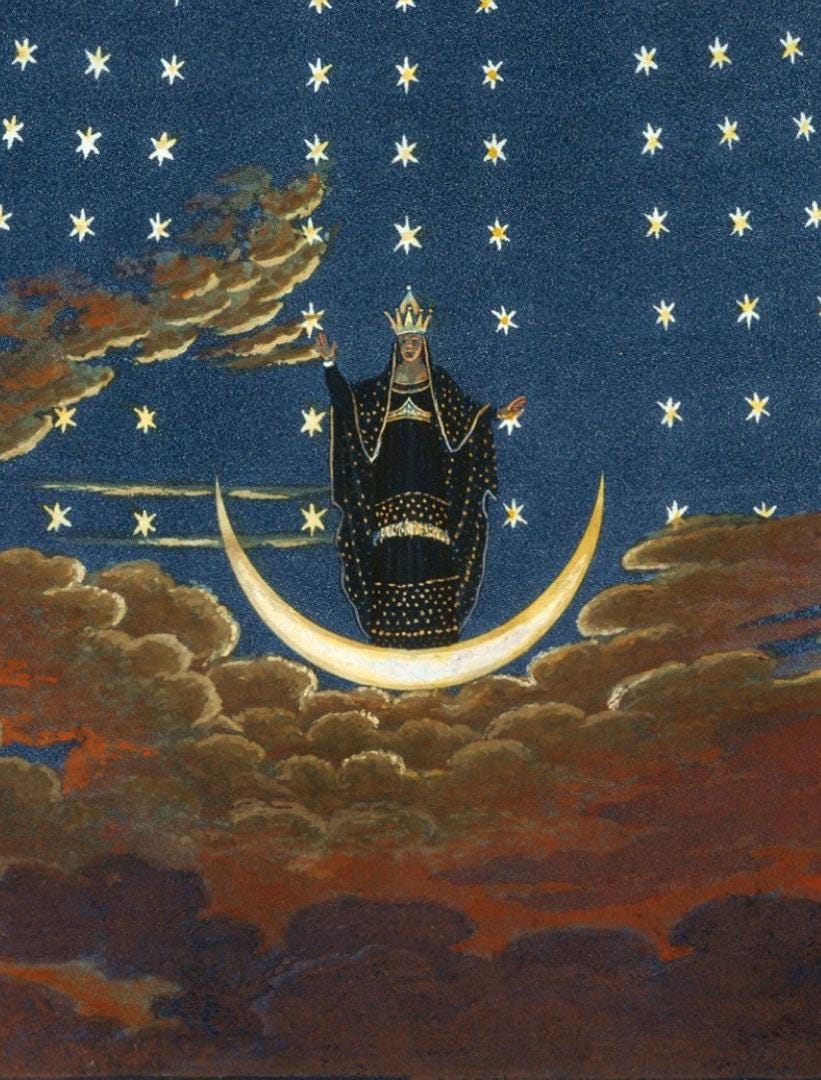
That’s where this scene comes in. By the early 1800s, productions of The Magic Flute had started to lean heavily into spectacle. Audiences weren’t just there for the music - they wanted to be transported. And Schinkel understood that better than most. He approached stage design like architecture, treating the set as a backdrop. He built entire environments - structured, immersive, and visually overwhelming in the best way.
The “Hall of Stars” is a perfect example of that approach. What you’re seeing in this dramatic print is essentially a fully imagined celestial palace. Not a realistic sky, but a designed one. The stars are arranged with intention, and the symmetry is deliberate. The space feels vast, but also controlled, like you’ve stepped into a universe that follows its own rules.
And remember, this was meant to be built on a stage. No CGI. No projection mapping. Just painted scenery, lighting, and physical construction. Everything had to be convincing enough, from a distance, to sell the illusion of standing inside the Queen of the Night’s domain. That’s part of what makes this image so impressive even now. It wasn’t created as a standalone artwork - it was functional. It had to support a live performance, frame the singer, and hold the audience’s attention without distracting from the music. And yet, it holds up completely on its own as a printed work of art.
There’s also something interesting about the timing of all this. Schinkel was working in a period where Romanticism was starting to take hold across Europe. There was a growing fascination with the sublime - things that felt vast, powerful, and slightly overwhelming. Nature, the night sky, ancient ruins… anything that reminded people how small they were in the grand scheme of things. This set taps directly into that.
The Queen of the Night isn’t placed in a simple throne room. She’s given an entire cosmos. It reinforces her presence before she even sings a note. You don’t need context to understand that this is someone who exists on an entirely different plane than the other characters. That’s good design. It tells you what you need to know without explaining it.
Over time, Schinkel’s stage designs became widely circulated as prints, which is how images like this survived long after the original productions. What started as temporary scenery for a live performance ended up becoming collectible artwork in its own right.
And that’s where this piece sits now. It’s no longer part of a moving production, but you can still feel what it was meant to do. There’s a sense of immense scale, a sense of atmosphere, and a quiet visual drama built into it.
In a modern space, it does something a little different than most wall art. It pulls your eye outward instead of inward. It gives the impression of space beyond the frame, which is probably why it feels so calm even though it’s visually detailed.
And if you know the context, it adds another layer entirely. You’re not just looking at a star-filled sky. You’re looking at a moment in a performance that once played out in front of a live audience, nearly two centuries ago. A piece of theater that had to convince people - without any modern technology - that they were standing in the palace of the Queen of the Night.
And for a few hours, I'll bet it surely did.