
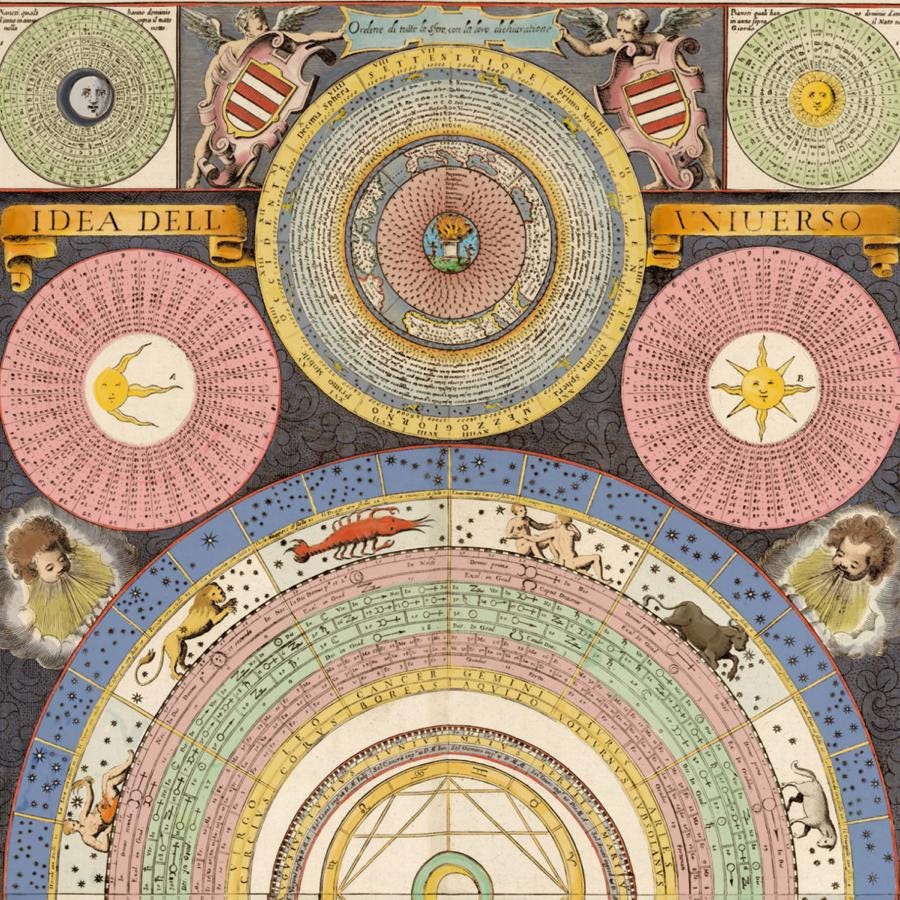
Vincenzo Maria Coronelli was a renowned cartographer, cosmographer, and encyclopedist of the 17th century. Today we feature his stunning work Idea dell'Universo (Idea of the Universe), a celestial chart that showcases the beauty and complexity of the universe in a way that is both entertaining and educational.
This celestial chart was created in 1693 and is considered a masterpiece of cartography. It is a detailed representation of the cosmos, depicting the stars, planets, and constellations in a stunning and intricate manner. The chart measures approximately 90cm in diameter and is made up of two hemispheres, one depicting the northern hemisphere and the other depicting the southern.
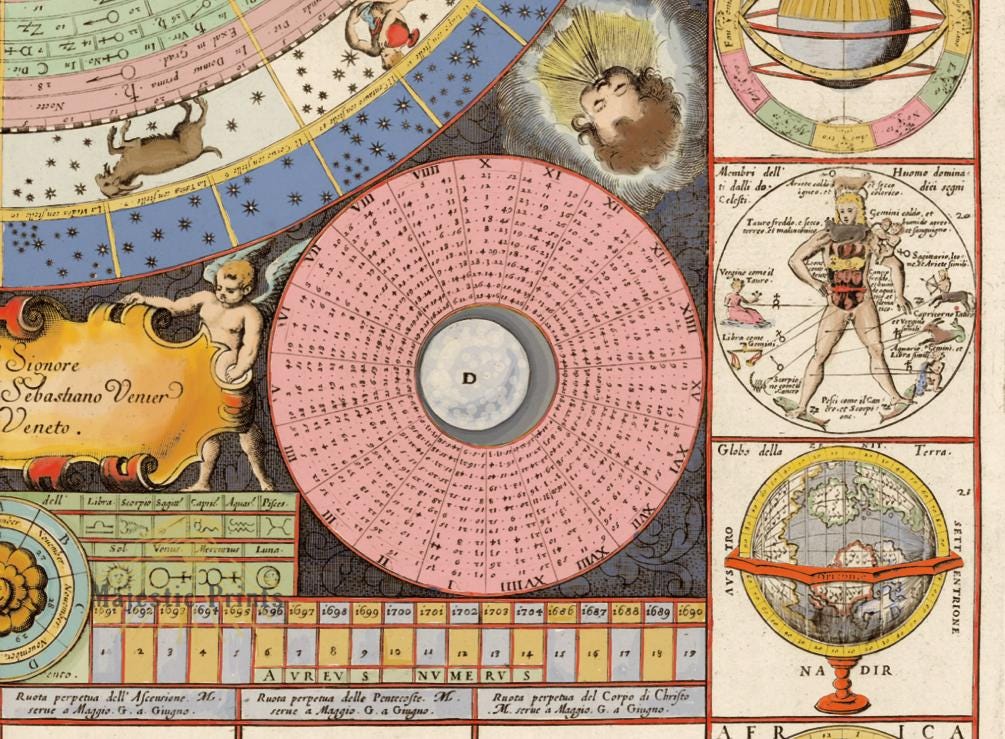
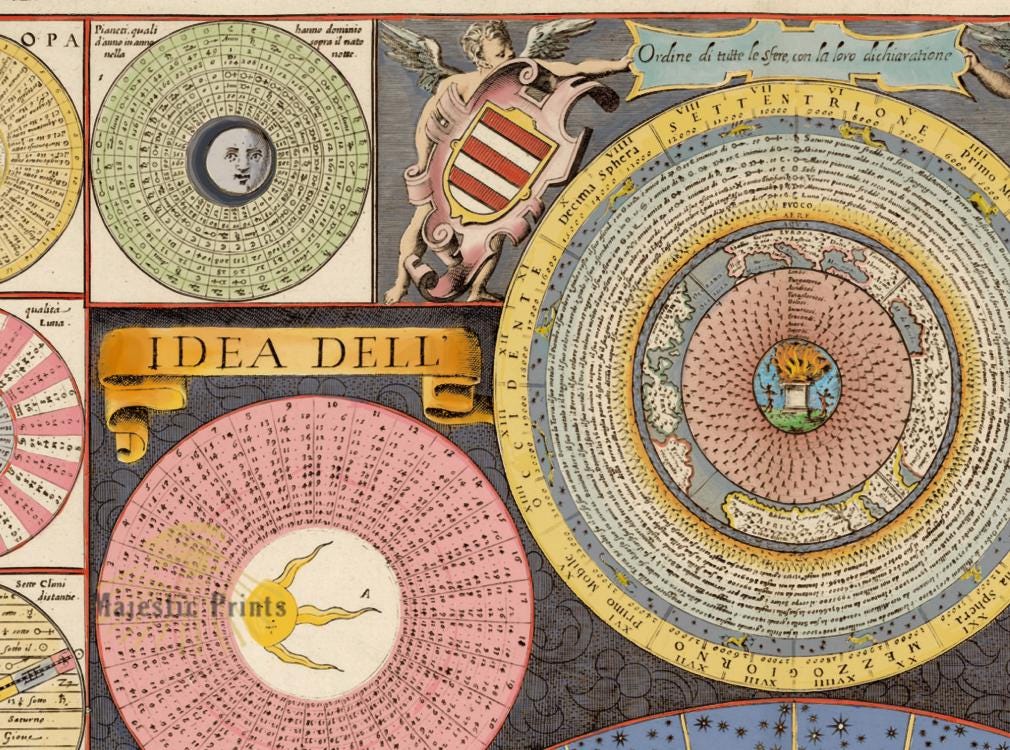
The chart is adorned with beautiful illustrations of the various celestial bodies, including the sun, moon, and planets, as well as an array of stars and constellations. Coronelli's attention to detail is evident in the chart, as he has included information about the position and movement of the celestial bodies, as well as their relative sizes and distances from each other.
One of the unique features of the chart is the inclusion of two globes, which were used to represent the celestial and terrestrial spheres. The celestial globe depicts the stars and constellations, while the terrestrial globe shows the continents and oceans of the Earth. This combination of the celestial and terrestrial spheres in one chart is a testament to Coronelli's brilliance as a cartographer and cosmographer.
The chart also includes a number of fascinating annotations and notes, which provide additional information about the celestial bodies and their movements. For example, Coronelli includes information about the phases of the moon, the eclipses, and the movements of the planets - alongside calendar systems, zodiac associations with parts of the human body, and a cross-section of Earth depicting the various circles of Hell as described in Dante's Divine Comedy.
That combination may feel strange now, but historically it makes sense. Coronelli was working at the end of the 1600s, when European knowledge was becoming increasingly scientific, but older cosmological, religious, and astrological traditions still remained part of how people organized the world. This chart does not represent “space” in the modern NASA sense. It represents a late 17th-century effort to visually arrange the known, debated, inherited, and symbolic parts of existence into one highly organized image.
The fact that Dante’s Hell appears alongside astronomical and astrological diagrams is one of the most memorable details. It shows that “the universe” was not understood as a simple physical arrangement of celestial bodies. It could also include moral geography, spiritual order, and literary imagination.
Dante’s Divine Comedy had shaped European visual culture for centuries by Coronelli’s time, and its layered structure of Hell, Purgatory, and Heaven gave artists and scholars a powerful way to picture the unseen world.
The chart also reminds us that maps dont have to be just neutral tools. Coronelli’s maps and cosmographical works were made to instruct and organize knowledge. They were practical, but they were also theatrical. The engraving is dense because the ambition was dense: to give the viewer a structured visual guide to a universe that included science, time, the stars, the body, the Earth, and the afterlife...
Our exclusive Color edition of Idea of the Universe was hand colored over a 20 hour restoration process using a rare colored original as reference to achieve the most authentic look possible. You will not find this amazing print anywhere else!